
Draw and Tell Method is a flexible learning sequence where students respond to teacher prompts through three modes of expression: drawing/making visual representations, the handwritten word, and spoken discussion.
Draw and Tell Method is grounded in three first principles:
Drawing reveals thinking.
Writing organizes thought.
Discussion deepens understanding.
...The student's thinking is already there.
The workbook gives it a place to appear
Could a simple classroom workbook, adaptable to any subject and any teacher's style, benefit your work?
The Draw and Tell Method Classroom Workbook could be a difference maker.
Great teaching has a new place to happen.
It's in this purple book.
Think of opening windows for seeing how your students approach ideas.
With these pages, you can identify patterns in how they learn, solve problems, and express themselves.
The workbook, with a repeating blank-page, lined-page layout, gives students a place to
- Explore ideas visually
- Develop ideas intellectually
- Organize thoughts in hand writing
- Prepare mentally for discussion
Teachers' Note: Discussion takes place when you feel it best serves the student, the lesson, or the situation, in one-on-one sessions, small-group, or whole-class settings.
Always teachers' choice.
The Draw and Tell Method Classroom Workbook becomes the student's personal think-lab where...
Drawing reveals thinking.
Writing organizes thought.
Discussion deepens understanding.
The three first principles.
The Draw and Tell Method Classroom Workbook complements your teaching style, is easy to implement, and easy to make your own.
This is your class.
Your method.
There is no student-directed language in the workbook.
Here's an example:
You begin with a prompt, a question, observation, or assignment.
The student draws or makes visual representations on the blank page, then handwrites on the adjacent lined page.
Discussion follows at the teacher's discretion.
How you use the Method is entirely up to you.
Questions?
Let's answer a few.
Q: Is this another art book? Do my kids need artistic ability?
A: The kids don't need artistic ability. And this is not an art book unless you choose to use it as one.
The Draw and Tell Method Classroom Workbook is intentionally designed to help you, help students think visually. The goal is not to produce artwork, but make thinking visible.
The drawing can be as simple as stick figures, circles, shapes, arrows, connected lines, or any mark that helps articulate thought.
Q: Will this change the way I teach?
A: It doesn't have to, but it could -- in a positive way.
The advantage lies in the freedom to make Draw and Tell Method your own method. The Method and Workbook are not here to interrupt the way you teach. They're here to complement what you already do well, and to help reinforce your objectives.
Q: Does this method require a computer or any other digital technology?
A: Absolutely not. All it takes is one pencil, one workbook, one student, one teacher, and a prompt to get started. No device required.
No login, no username, no password, no charging, no software, no Wi-Fi... no screen between the teacher and the student -- which makes Draw and Tell portable. Meaning the classroom can go where you decide to take it.
Always teachers' choice.
Q: Does this work with the curriculum I already use?
A: Yes. It can work with any curriculum.
The Draw and Tell Method Classroom Workbook can be used on its own or alongside textbooks, videos, and online learning platforms. Any lesson or exercise can become the prompt. Students use the blank page to represent their understanding and the lined page to explain their thinking.
Q: How am I supposed to grade something like this?
A: You don't have to, or you could.
Draw and Tell is not a grade-centered activity unless you want it to be one. The value is seeing how the student approaches your prompt, what they notice and what they don't -- and how they express their thinking. That's the tell.
The draw can be anything. The tell can be everything.
Q: Will I be making more work for myself?
A: Draw and Tell is meant to work with you, not add to your workload.
You don't need a Draw and Tell schedule -- unless you want one. You can use this every day, once per week, once per month -- or only when a situation calls for it.
There is no complicated learning curve, however you may enjoy the discovery curve -- finding new ways to use Draw and Tell, and new ways to see how your students think.
Use it when and where it best serves you and your students.
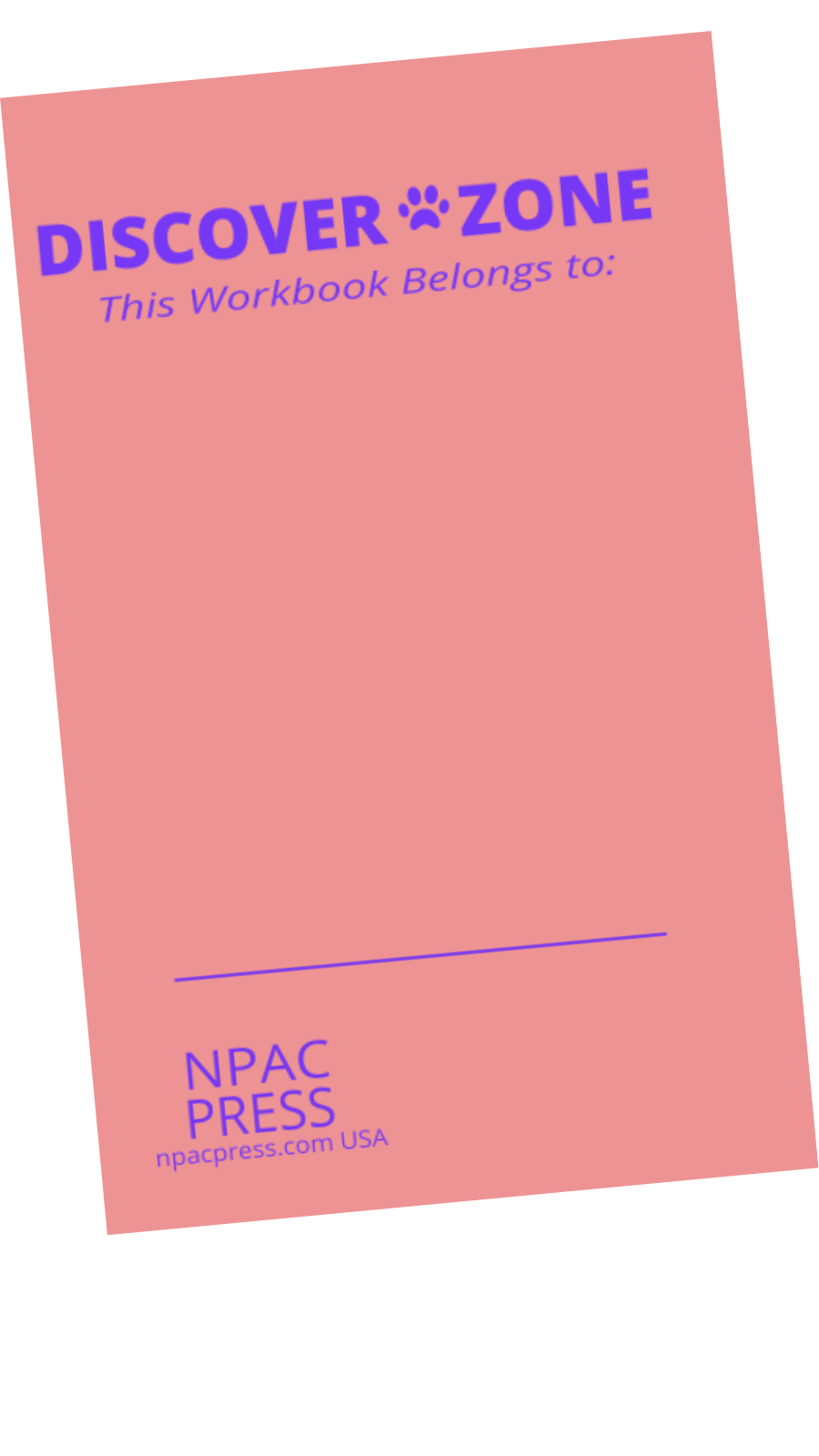
And the back cover loves permanent markers. With lots of room for student name, class and date, Discover Zone is where identity lives.
And students can have a field day personalizing their own back covers -- making it easy for you to recognize at a glance.
*Bell rings.
"Put your purple books on my desk before you leave... face down please."
Teacher Talk
Sometimes a question comes my way that's simply too good not to share. When that happens, I answer and share the Q&A in Teacher Talk, the email.
If you'd like to read Teacher Talk, enter your email below. I promise to keep your address private. You can unsubscribe anytime you like with one click. And I'll only ever send something when I believe it's worthy of your attention.
Thank you for subscribing!
Do you have a question or an experience you'd like to share? Please send it to me at info@npacpress.com.
My name is Nicholas Petti, but Nick is fine.
I respond to all correspondence -- and with your permission -- your Q and my A may appear in a future Teacher Talk.
Thanks for reading. And thank you for what you do.
May we all keep learning,
Nick
Draw and Tell Method Classroom Workbook is available on Amazon

npacpress.com NPAC PRESS USA email: info@npacpress.com